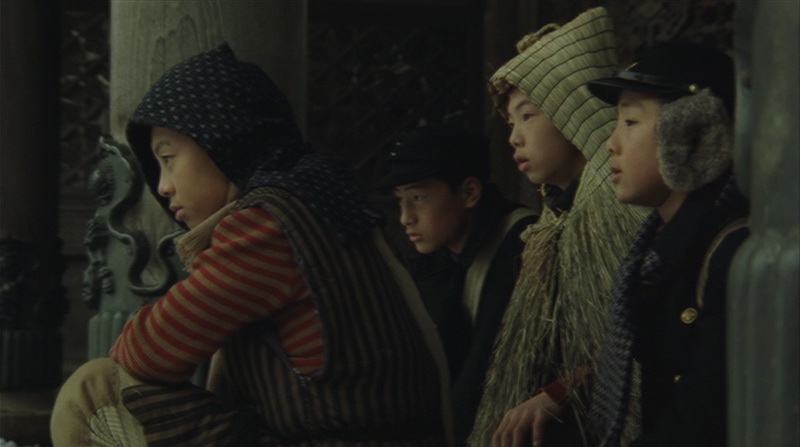
There is just so much to unpack in Masahiro Shinoda’s Takeshi: Childhood Days (‘Shounen jidai’), an unassuming film from 1990 about Shinji, a Tokyo boy who took refuge in rural Japan at the closing year of the Pacific War.
What would’ve been a story about how he faced the usual rigors of pre-teen years—peer pressure, socialization in a juvenile dog-eat-dog mini ecosystem, formation of the self, academics, and bullying—is enriched by the unique context of a nation at the height of war.
While Shinji and his adoptive community were spared from the bombs and the bloodshed, the war still reached its long, unrelenting arms through various means. Men, even from that rural village, had to be sent away to fight the war, their loved ones anguished with being left behind. They would be subject to Imperial propaganda (and even a film about the German Fuhrer!), and eventually, the American occupation. There is really so much to mine here that if I were to teach about the Pacific War and its depiction in cinema, I would certainly include this as required viewing.
Another strength of this film is in its quietness, and by that I don’t mean that there is sparse dialogue. The visuals are measured and the mise-en-scene throughout the film is well-composed and clean. This is perhaps to stand as a contrast to what the characters and the viewers would imagine as the noisy, bloodied, and utterly destroyed cities of Tokyo, Hiroshima, and Nagasaki, among others. Save for a brief scene of people running away from burning houses, the film only talked about Tokyo being bombed but never shown. This is where the film invokes the power of cinema’s unique language—editing. By leaving out certain scenes and showing others, the film invites viewers to imagine for themselves scenes that are not present and proximate but are paramount to the lives and fates of the people in Shinji’s community.
This wouldn’t be complete without talking about Shinji and Takeshi, the two boys at the center of this film. The film made a deliberate choice of telling the story of Takeshi, the title’s namesake, from the point-of-view of Shinji.
Perhaps the reason for this is how Takeshi became central to Shinji’s experience of being a local war refugee, how he mediated, both implicitly and explicitly, the different layers of context that the film tackled, as they played out in the life of Shinji.
Or maybe it’s the other way around? Shinji becomes central to Takeshi’s experience and understanding of the World War that Japan is participating in, making him understand that the war is national in both effort and reach, and that his little shounen life will be disrupted by it through the life of another boy. Again, this is left for the viewers to imagine and decide.
However it is, the film does not depict a simplistic relationship. There lies Shinoda’s filmmaking prowess, elevating what could’ve been a common story between two boys into a rich cinematic gold mine.
 Film reviews in 500 words or fewer