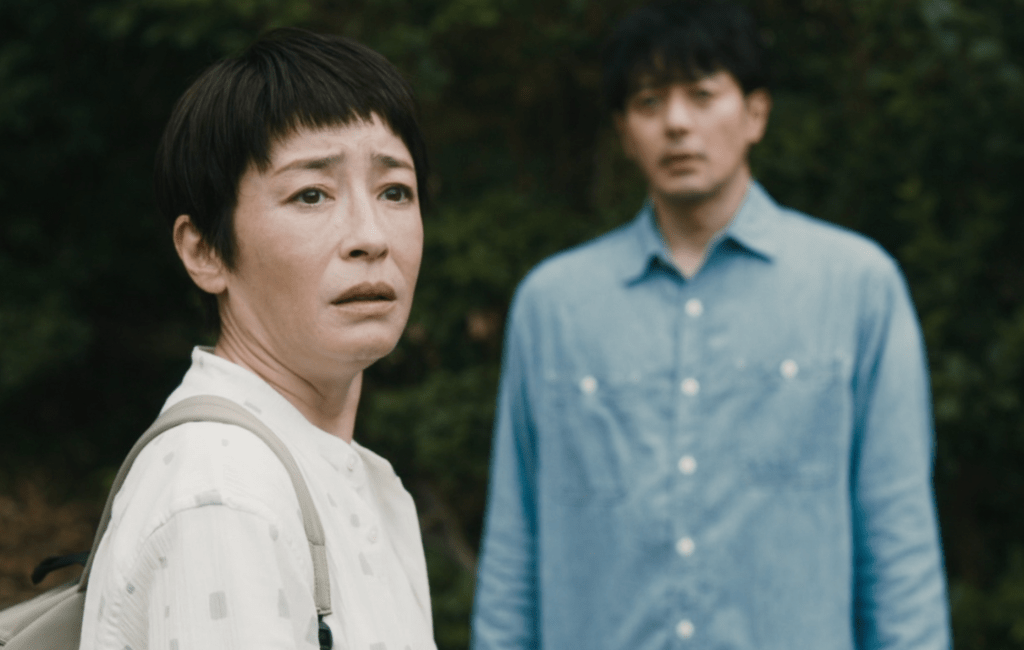
“No one wants to see the truth.” But in attempting to open one’s eyes to the truth and tell it to the world, what will one actually come to know?
Seeing the truth and knowing it are two different things. This is a powerful dichotomy that runs through Yuya Ishii’s The Moon, giving this film guiding threads to pull together its disparate themes.
Yoko, played with signature tenderness and nuance by Rie Miyezawa, is an award-winning writer who begins a caregiving job at Crescent Garden, a facility for the disabled. This facility, nestled deep in a forest, plays a major emotional role in the movie as it emanates a tension that never quite eases. It is depicted with classic horror tropes— the ominous score hinting at an impending or already happening disaster, the dimly-lit hallways, the overhead shots suggesting someone/something is watching, and the uncanny demeanor of the people who work here.
It is through Crescent Garden and what it stands for that the film explored various questions; it is the object of the truth that needed to be seen, known, and made known.
For example, Yoko wanted to work in this facility to help her deal with past personal trauma, but will she, as a writer, open her eyes to the horrific truth about the facility and write about it truthfully? Or will she succumb to conceit and write only what would sell? This is a challenge constantly raised by her co-workers–her namesake Yoko (Fumi Nikaido), who aspires to be a writer of the same caliber as her, and Sato (Hayato Isomura in a brilliant performance), a seemingly sympathetic caregiver with an increasingly mysterious undercurrent.
Both Yoko 2 and Sato’s own personal issues are also dealt with through the lens of the facility. For Yoko 2, it’s the question of personal worth. For Sato, it’s the meaning of being human itself. Concurrently, the film also tried to address the grief of Yoko 1’s husband, Shohei (Joe Odagiri), although not directly in relation to the facility itself.
While well-intentioned, this attempt to offer answers to every philosophical question that the narrative met along the way has made for an unnecessarily long but somehow incomplete film, as some of the big questions that the film opened were not satisfyingly answered. It is also a bit uncanny that the film tries to be about the disabled, disability, and their place and dignity in society, but much of the exposition of this theme comes from the abled.
The film naturally resolved from the perspective of Yoko 1, who saw the truth and knew what it meant for her personally and in relation to exposing it to the public. But in the end, you will be hard pressed to know what kind of film this is. A melodrama? A psychological thriller? A philosophical slasher? There are a lot of films that are genre-agnostic, but the sort of thematic mishmash in The Moon didn’t quite build into a solid whole.
3/5
 Film reviews in 500 words or fewer